KB1SO Station
Explore the KB1SO HF amateur radio station, featuring remote operation, custom C++ station-control software, homebuilt solid-state amplifiers, and a 10-antenna contesting system.
Blog 11/22/2026 by Ray
Welcome to the KB1SO Amateur Radio Station
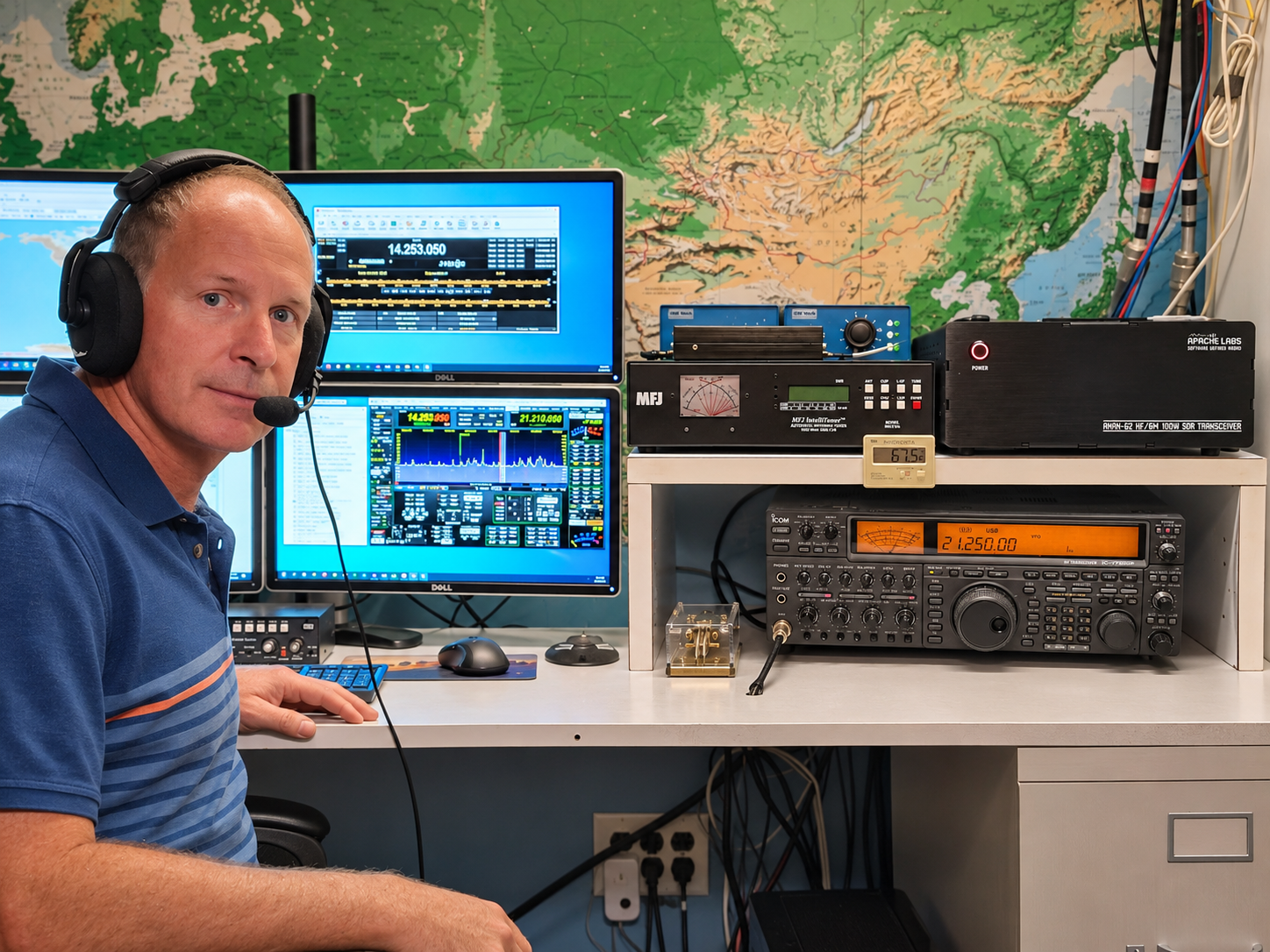
Welcome to my amateur radio station, KB1SO, located in New Hampshire.
I'm Ray Faucher, an Extra Class amateur radio operator, first licensed in 1981 and active in amateur radio for over 40 years. My primary interests include HF contesting, equipment homebrewing, RF engineering, and software development.
Over the years, I've been associated with several amateur radio organizations, including the American Radio Relay League (ARRL), Yankee Clipper Contest Club (YCCC), and Nashua Area Radio Club.
The KB1SO station is more than a place to operate. It's also an engineering laboratory where I design, build, test, and integrate RF equipment and develop software to control and monitor the station.
The KB1SO HF Station
My station is designed for HF contesting, DX operating, digital communications, and remote operation.
One of its distinguishing features is the extensive use of custom C++ software for integrated station control. Remote operation has included control of the FlexRadio transceiver, homebuilt 1.5 kW+ solid-state amplifier, ten antenna systems, RF meters, antenna switches, and rotators.
Rather than relying exclusively on separate equipment controls, I prefer bringing station functions together through software.
Transceivers
The station has included several transceivers and software-defined radios:
- Apache Labs ANAN-G2 — Current primary SDR transceiver.
- Hermes-Lite 2 — Compact SDR used for operating and experimentation.
- Icom IC-775DSP — Traditional HF transceiver.
- FlexRadio Flex-5000A — Previous primary SDR, replaced by the ANAN-G2.
Amplifiers and Supporting Equipment
- KB1SO homebuilt 1.5 kW+ LDMOS solid-state amplifier
- Mercury LUX solid-state amplifier
- Additional homebuilt solid-state RF amplifier designs
- High-power bandpass and low-pass filters
- RF power and SWR measurement equipment
- Custom antenna switching and station-control systems
Much of the station equipment has evolved through years of practical operating experience, engineering experimentation, and software development.
The Antenna Farm
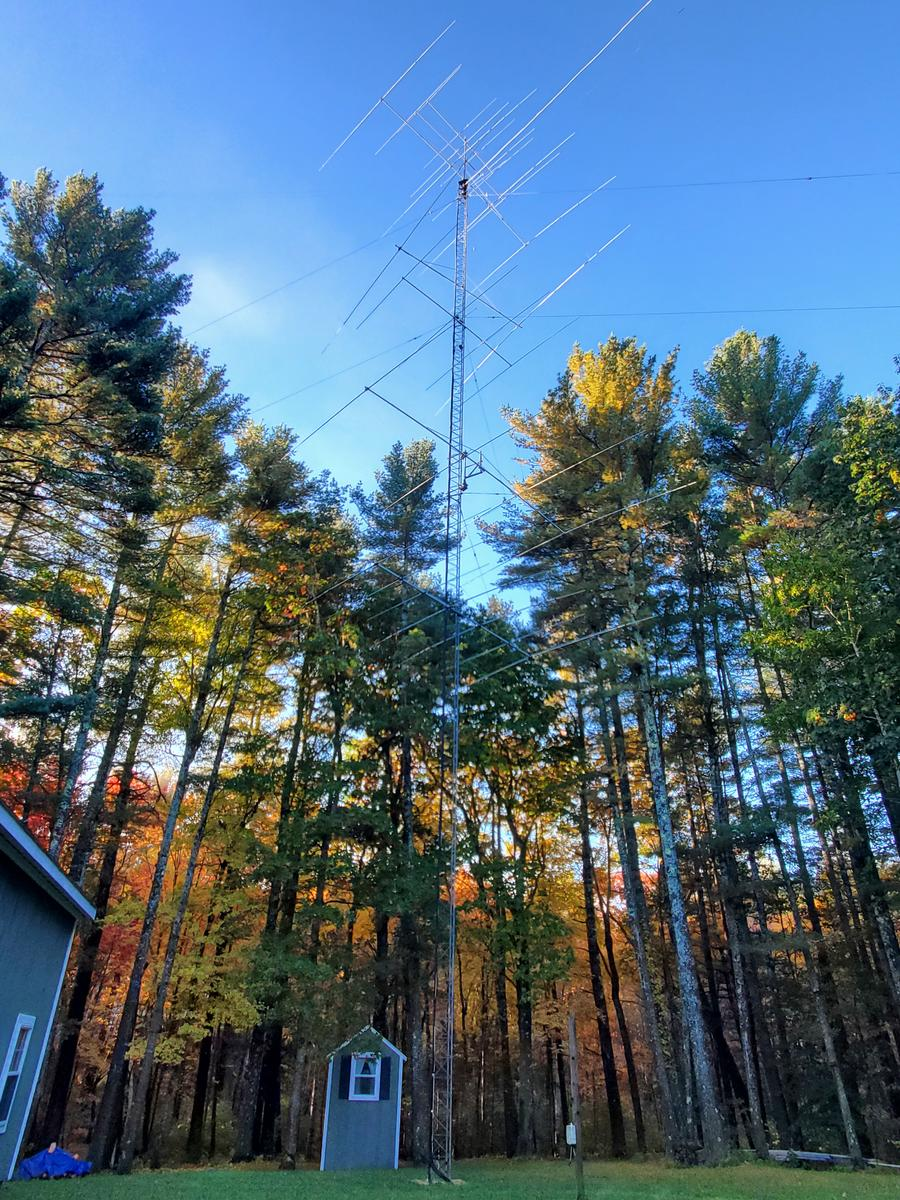
The KB1SO antenna installation is built around a 120-foot Rohn 45 tower, complemented by a 45-foot Rohn 45 tower attached to the house for supporting wire antenna ends.
Ten antenna systems provide coverage across the HF amateur bands from 160 through 10 meters.
| Band | Antenna System | Height / Configuration |
|---|---|---|
| 10 m | 4-element Yagi | 135 ft — Top rotor |
| 15 m | 4-element Yagi | 129 ft — Top rotor |
| 15 m | 4-element Yagi | 90 ft — Fixed at 60° |
| 10/15/20 m | TH7DX tribander | 50 ft — Fixed at 60° |
| 20 m | 4-element Yagi | 124 ft — Top rotor |
| 20 m | 4-element Yagi | 62 ft — Bottom rotor |
| 40 m | 2-element Yagi | 100 ft — Fixed at 60° |
| 80 m | Northeast inverted L | 120 ft apex |
| 80 m | Southwest inverted L | 120 ft apex |
| 160 m | Northeast inverted L | 122 ft apex |
The installation supports stacked Yagi operation, including 4-over-4-element arrays, providing additional flexibility for contesting and DX.
Three runs of CommScope LDF5-50A 7/8-inch hardline connect the station to the antenna systems.
Built for New Hampshire Winters
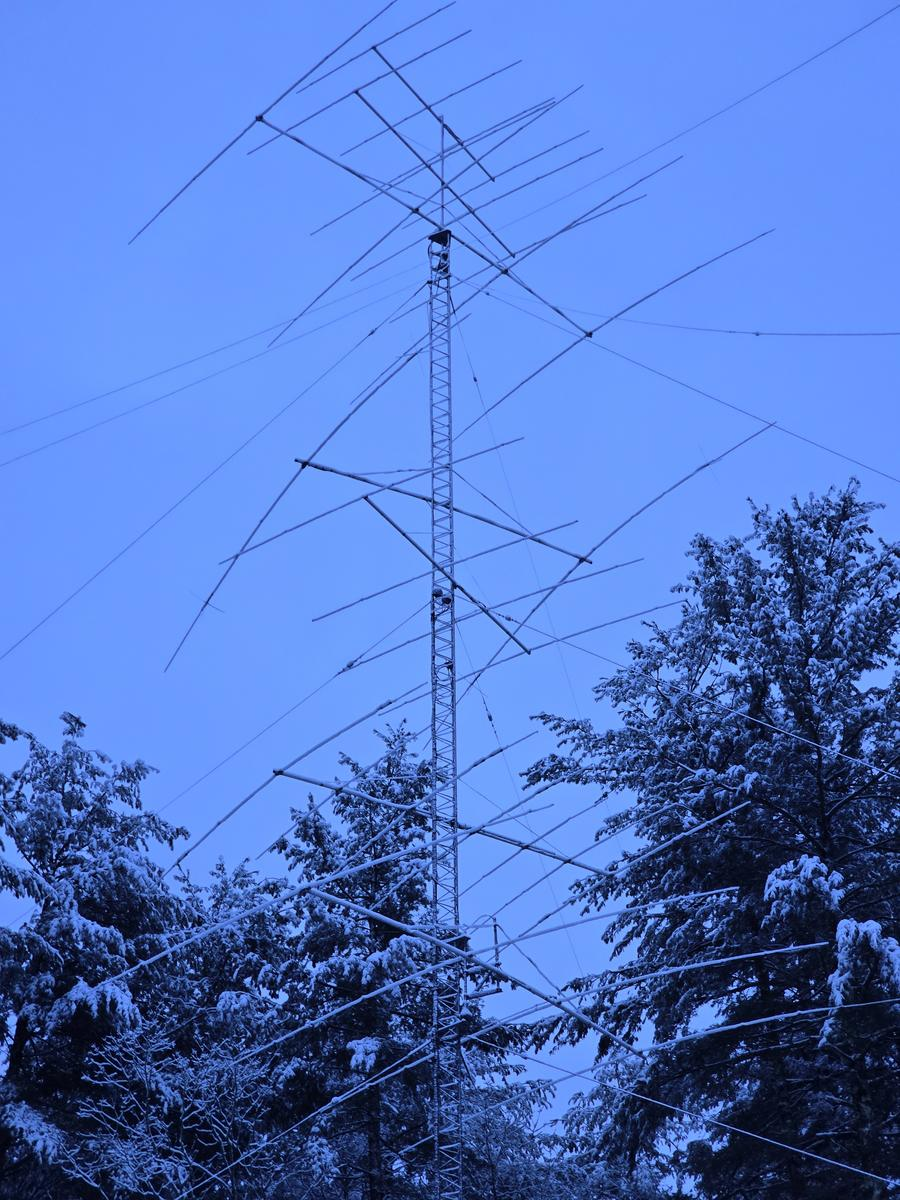
Ice and wind loading are important considerations for a large antenna installation in New Hampshire.
The Yagi antennas use reinforced, double-wall-thickness elements near their centers to help withstand heavy winter ice conditions.
Station photographs show the antennas during fall and winter, including an approximately one-inch ice accumulation.
 |  |
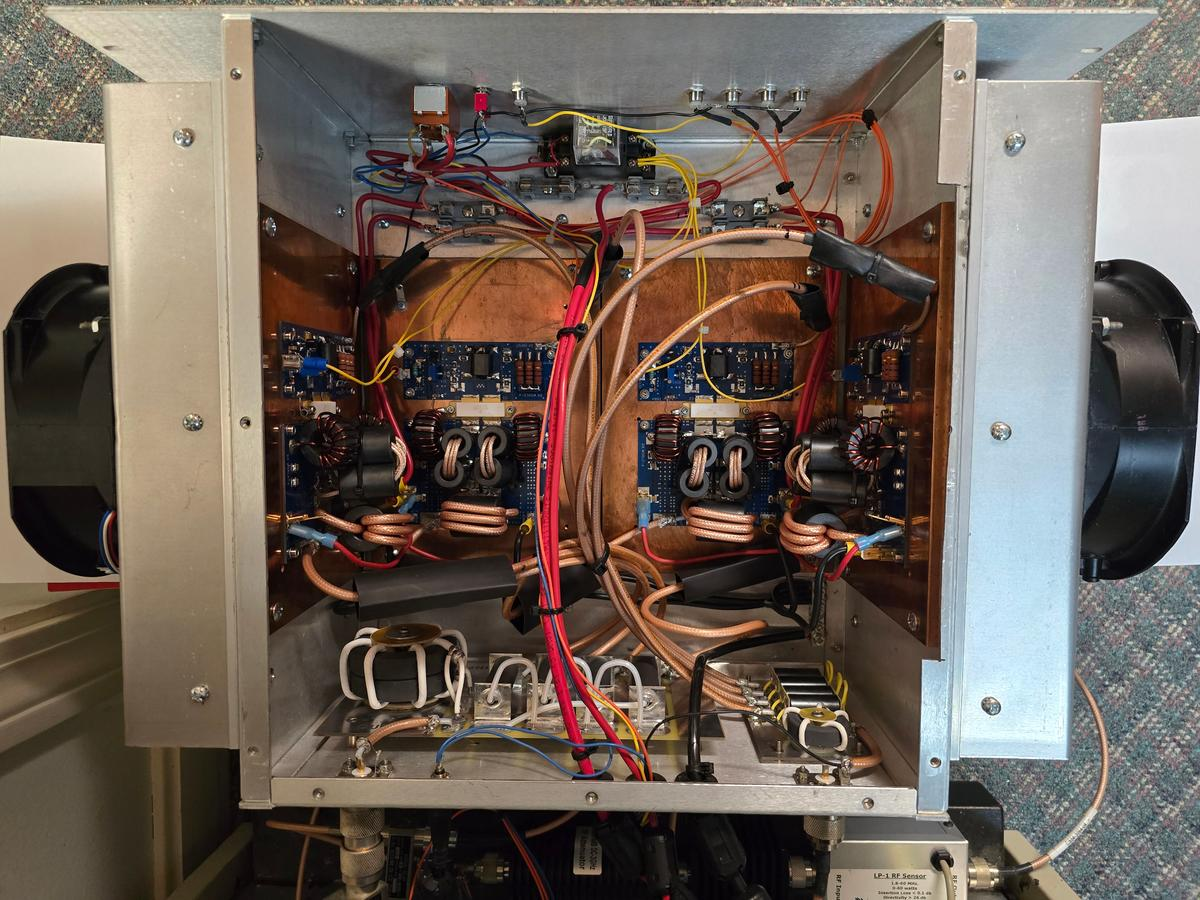
Homebuilt 1.5 kW+ Solid-State Amplifier
Designing and building RF amplifiers has been one of my favorite engineering activities.
My original KB1SO amplifier used four RF amplifier modules containing a total of 16 SD2933 MOSFETs. The design was capable of producing 1.5 kW with 100% duty-cycle operation.
February 2025 — LDMOS Upgrade
In February 2025, I replaced the original MOSFET amplifier modules with modern high-ruggedness LDMOS devices.
The updated amplifier contains four RF modules, each using a single MRFX1K80H LDMOS transistor, rated for 1.8 kW.
Rather than operating the transistors at their maximum ratings, I run them at a reduced 48 V DC supply voltage, with higher bias, to prioritize excellent linearity and intermodulation performance.
Some measured performance characteristics include:
- RF output on 10 meters: 1.5 kW, measured after the low-pass filter
- Required RF drive: Approximately 3.25 W
- Efficiency: 85.3%
- RF gain: Approximately 30 dB on 160/80 meters and 27 dB on 10 meters
- Input attenuation: A switched 12 dB attenuator protects against excessive drive
The amplifier receives power from a telecom-grade 48 V DC, 100 A power supply located in another room.
The amplifier's low-pass filters are external to the RF deck and housed in a separate enclosure.
Clean RF Performance
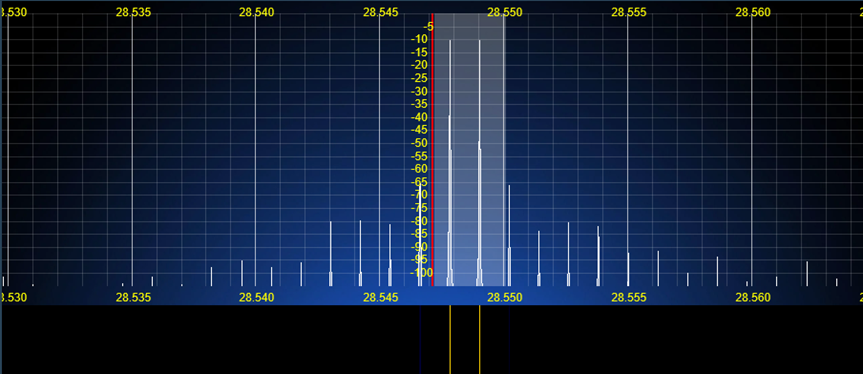
An important design objective has been producing a clean transmitted signal rather than simply maximizing RF power.
My measurements indicate harmonic suppression comfortably exceeding the applicable requirements of FCC 47 CFR § 97.307(d).
Two-tone intermodulation testing at 1 kW RF output produced:
- IMD3: −55 dBc
- IMD5: −70 dBc
These measurements reflect the emphasis placed on linearity, amplifier biasing, filtering, and overall RF performance.
RayStationUtil — Custom Station-Control Software
One of the most important developments at the KB1SO station has been RayStationUtil, my custom station-control application written in C++.
The software was developed to bring numerous station-control and monitoring functions into one application.
Capabilities include:
- Transceiver and station-equipment integration
- RF amplifier monitoring and control
- Forward and reflected power measurements
- SWR monitoring and diagnostic plotting
- Antenna switching and selection
- Remote station operation
- Equipment status and operating information
The software integrates equipment that would otherwise require several independent controls and instruments.
Software-Based RF Instrumentation
RayStationUtil also provides useful engineering diagnostics.
For example, the application can generate SWR-versus-frequency plots for evaluating antenna performance.
I've used these tools to examine the 10-meter four-element Yagi and the 15-meter 4-over-4-element antenna array.
The application screenshots show the ANAN-G2 operating with my four-module LDMOS amplifier. The amplifier input measurement includes the switched 12 dB attenuation used with the ANAN-G2, while feedline power is measured after the station's bandpass filters.
The Hermes-Lite 2 can also drive the amplifier to the full legal power limit across the supported amateur bands.
For me, RayStationUtil represents the natural intersection of amateur radio, RF engineering, embedded equipment integration, and software development.
HF Contesting, DX, and Digital Modes
HF contesting has long been one of my primary amateur radio interests.
The combination of large antenna systems, equipment performance, operating strategy, and propagation makes contesting both challenging and rewarding.
I also enjoy DX operating, experimenting with software-defined radio technology, and using digital modes.
The station supports applications such as WSJT-X, including FT8 operation.
One example is a 15-meter FT8 session using the ANAN-G2 and Mercury LUX amplifier at approximately 400 W.
My operating history includes contacts across the United States and internationally, reflected in various awards on my QRZ profile, including DX World, World Continents, U.S. Counties, and Grid Square awards.
Amateur Radio and RF StateSide
Much of my engineering and software development work has been influenced by the practical requirements of the KB1SO station.
Projects involving RF power measurement, amplifier control, antenna switching, instrumentation, and communications interfaces all have connections to my amateur radio interests.
These experiences have also contributed to the development of RF StateSide, LLC.
Today, RF StateSide focuses primarily on software development, including desktop applications, simulation tools, engineering instrumentation, embedded-system integration, and open-source software.
The KB1SO station continues to serve as a hands-on engineering environment where software and hardware come together.
You can explore related projects on the RF StateSide Projects page.
More About KB1SO
Like most amateur radio stations, KB1SO continues to evolve as equipment changes, new technologies become available, and new engineering ideas emerge.
For more station photographs, equipment details, operating activity, and awards, please visit my amateur radio profile:
Thanks for visiting the KB1SO station!
73,
Ray / KB1SO
RF StateSide, LLC
No tags
Recent Blogs
Explore the KB1SO HF amateur radio station, featuring remote operation, custom C++ station-control software, homebuilt solid-state amplifiers, and a 10-antenna contesting system.
Read More...
RF StateSide is beginning a project-by-project transition to public engineering references, open-source software, and open hardware so others can use, study, continue, and improve the work.
Read More...